GUIDE · PARENTS
When Is a Child Ready for Pointe
What dance medicine actually says about pointe age — and how to recognise a studio that respects the answer.
Alexandra·7 min read·MAY 2026
Parents arrive at this question with a phrase already in mind: is she ready? The answer is uncomfortable for studios that sell pointe as a milestone, and clear for the dance-medicine literature that has studied the body underneath. There are three things to settle before a parent can hold the question calmly: what the international consensus actually says about age and preparation, what a real pre-pointe assessment looks like and what it measures, and how to recognise a Vienna studio that respects readiness over a parent's hope or a child's wish. The article that follows is on the side of the child's body.
What the consensus actually says
The keystone document is the 2009 IADMS Resource Paper "Guidelines for Initiating Pointe Training," written by an orthopaedic surgeon, a Royal Ballet School educator, and a physical therapist — Weiss, Rist, and Grossman. The paper sets four working conditions before a first pointe shoe. The chronological floor is age twelve. The training history is roughly four years of classical ballet, with pointe entered in the fourth year for a child who began at age eight or later. The class frequency is twice weekly at minimum; once-a-week ballet does not build the conditioning the work requires. The anatomical condition is documented strength and alignment through the feet, ankles, trunk, and pelvis.
A useful comparator is Washington University Orthopaedics, whose clinical pre-pointe checklist accepts age eleven, three years of training, and three classes a week. Twelve is the safe default; eleven is the absolute floor with full readiness; anything below is contested by the literature.
The pre-pointe assessment — what it actually measures
A proper studio runs a battery, not a guess. The peer-reviewed reference is Richardson, Liederbach, and Sandow, "Functional Criteria for Assessing Pointe-Readiness," published in the Journal of Dance Medicine and Science in 2010. Three functional tests sit at the centre.
The sauté test asks for sixteen consecutive single-leg sautés on each foot, maintaining neutral alignment throughout — no foot pronation, no inward knee, no pelvic drop. The airplane test asks for four of five controlled pliés in a forward-pitched single-leg position, trunk parallel to the floor, back leg extended, arms out, pelvis square. The topple test asks for a single pirouette en dehors from fourth position with a controlled, decelerated landing. Physio-pedia and the Harkness Center for Dance Injuries at NYU Langone add twenty-five single-leg relevés on demi-pointe and clean alignment through foot, knee, and hip as routine endurance benchmarks.
A child who passes the battery is anatomically ready. A child who does not pass is not — regardless of age, regardless of how many friends started last spring. The assessment takes about twenty minutes and is something a parent can reasonably ask to observe.
Why twelve, and what happens before
The age is drawn from skeletal maturity, not arbitrary tradition. The distal tibia and fibula — the bones above the ankle — begin closing their growth plates around age twelve in girls and thirteen in boys, with most fusion complete between fourteen and seventeen, according to the Crowder and Austin 2005 forensic dataset. The sesamoid bones beneath the great toe typically appear only after age twelve and ossify on their own variable schedule. The girls who are most often pressed toward pointe — ages eight to twelve — sit inside their fastest growth spurt, the window where bone outpaces supporting soft tissue and tolerances are at their thinnest.
The published case material is sparse but specific. Shah's 2017 case report in Clinical Journal of Sport Medicine describes a thirteen-year-old, on pointe since the age of ten, whose right second toe had visibly shortened — premature arrest of the second metatarsal growth plate. The number twelve is not a guarantee. It is a precaution that costs nothing to honour.
What "too early" actually does
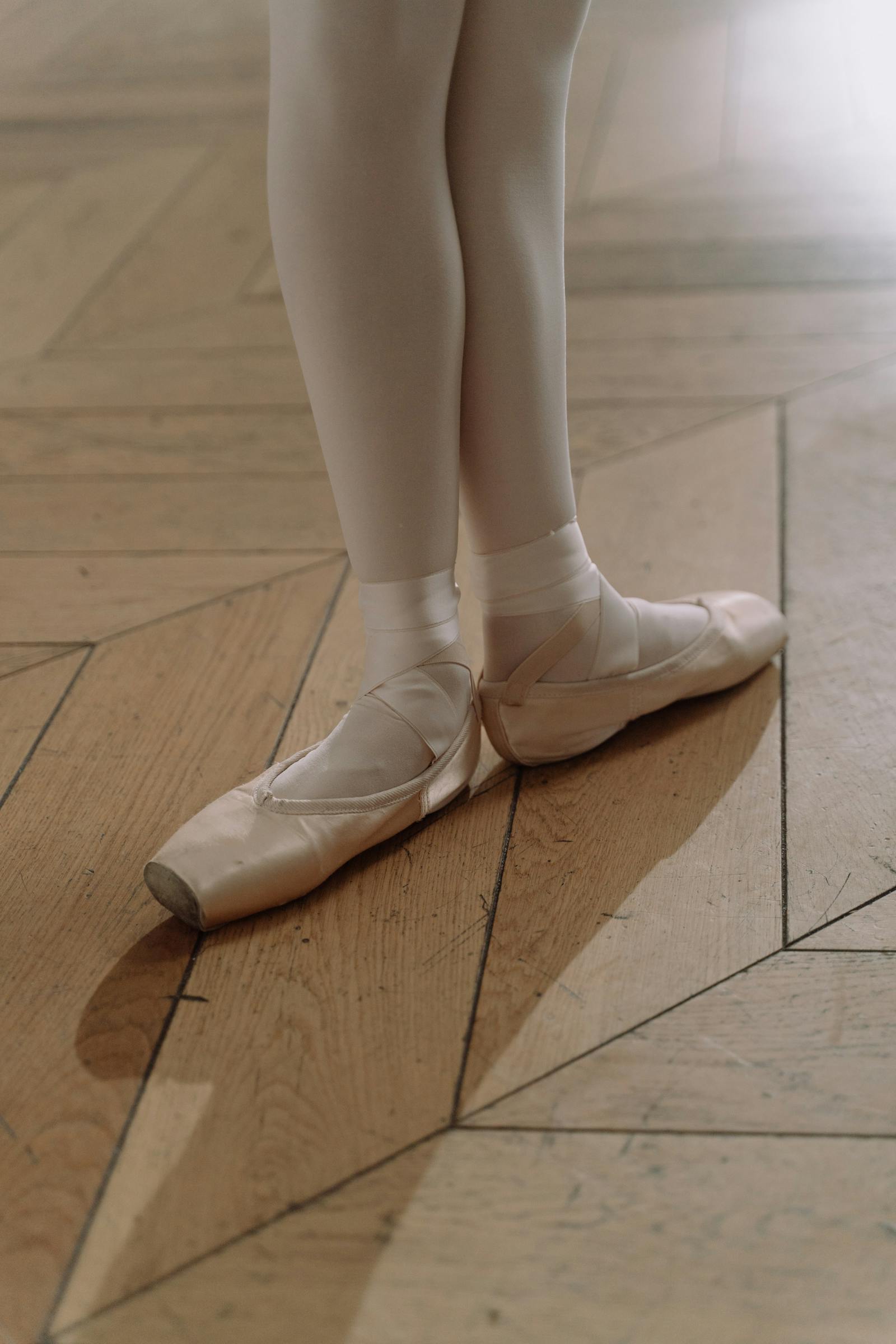
The mechanical reality is concrete. A dancer en pointe transmits roughly twelve times body weight onto the head of the first metatarsal, a focal load no recreational activity produces. Children's Hospital Colorado's paediatric dance-medicine programme cites the figure directly. In a foot whose bones are still ossifying, the load distorts where the bone is softest.
Three patterns recur in the literature. Hallux valgus — the bunion at the base of the great toe — appears more often in adolescent dance athletes than in age-matched non-dancers, with measurable microtrauma at the metatarsophalangeal joint. Stress fractures of the second metatarsal base were first described in ballerinas by Micheli in 1985; in a study of 150 trainees aged ten to twenty-one at La Scala in Milan, nineteen presented these fractures, almost all at the second metatarsal. Growth-plate damage, while rare, has been documented in case reports such as Shah 2017.
The 2022 Hough-Coles and Wyon systematic review is honest about the evidence base: no large prospective study has proven that early pointe causes a higher injury rate. The argument is precautionary, drawn from biomechanics and case material. Twelve is what the precaution costs; ten or eleven costs irreversibility in some cases.
The studio that respects the answer is the one to trust
ARTIS in Vienna teaches the Vaganova method and follows the IADMS pointe-readiness consensus. The pre-pointe assessment is part of the path, not a marketing event.
Adults on pointe — yes, with the same preparation
Adult onset is possible and increasingly common, and dance medicine treats it as legitimate. The four conditions still apply — roughly four years of consistent classical training, at minimum twice weekly, documented strength and alignment, a pre-pointe assessment before the first shoe. An adult body brings advantages: fully ossified bones, executive control of the work, no growth-plate question to weigh. It brings disadvantages too: slower tissue adaptation, longer recovery from setbacks, and in some cases low bone density that warrants medical clearance before loading. A studio that takes adult pointe seriously runs the same battery as for an adolescent. Pointe is a discipline, not a milestone, and the discipline begins at the assessment.
What to ask a studio
Five questions answer it. First, what is the studio's minimum age for pointe? Anything below twelve without an explicit readiness exception is a no. Second, how many years of training are required before a first pointe class? Four is the IADMS number; three is the loosest serious clinical bar. Third, does the studio use a written pre-pointe assessment battery? If yes, ask to read it; if no, that is the answer. Fourth, who decides when a student is ready — the parent, the student, or the teacher? The honest answer is the teacher, supported by the battery and by a physical therapist when one is available. Fifth, where is the first pair fitted? In Vienna the experienced fitters are Wilhelm Schachtner on Edelhofgasse, House of Dancing on Jörgerstraße, and Jump In on Neubaugasse — never the studio reception.
A studio that meets these five signals is teaching the child in front of it. A studio that misses two or three is selling a milestone.