GUIDE · CHILDREN
Children’s Ballet at 3, 5 and 8 What Actually Happens in Class
A parent’s walk through a children’s ballet class at each age: what your child does, wears and learns, and what a good school never asks of them.
Alexandra·7 min read·SEPTEMBER 2026
Parents who write to a ballet school for children usually have two questions underneath whatever they ask: is my child ready, and what will they do in there for an hour. A separate guide on this site answers the first, with what the research and the great academies say about age. This one answers the second. It walks through a children’s ballet class at three, at five and at eight, as a parent would see it from the doorway: what the children do, what they wear, what the teacher asks of them and what she does not. The discipline is the same at every age. What changes is how much of it a child can hold at once.
Three and four: play with a shape
At three, a child cannot hold a barre exercise, and nobody should ask them to. Attention at this age comes in short bursts, so a good Pre-Ballet class is built from short things: a song with a walk in it, a game that happens to end in first position, a moment of stillness that is really a lesson in waiting. At ARTIS the Pre-Ballet group for three- and four-year-olds meets for forty-five minutes, once a week at the weekend or twice a week, and the activity changes often because that is what the age needs.
What the children learn is more than it looks like from the doorway. They learn to stand tall and find their balance on one foot for a breath. They learn where the arms go in the first positions and that the feet have positions too. They learn to hear a rhythm and move on it, to start when the music starts and stop when it stops, and to wait while another child has a turn. Listening, waiting and posture are the real content of the year; the French words arrive as sounds attached to games. From the first class the youngest are addressed as “ladies”, a classical tradition that tells a three-year-old, without a lecture, that this room takes her seriously.
Comfortable clothes or a leotard, with socks or soft ballet shoes, are all that is needed. Nothing has to be bought before the trial.
Five, six and seven: the first real barre
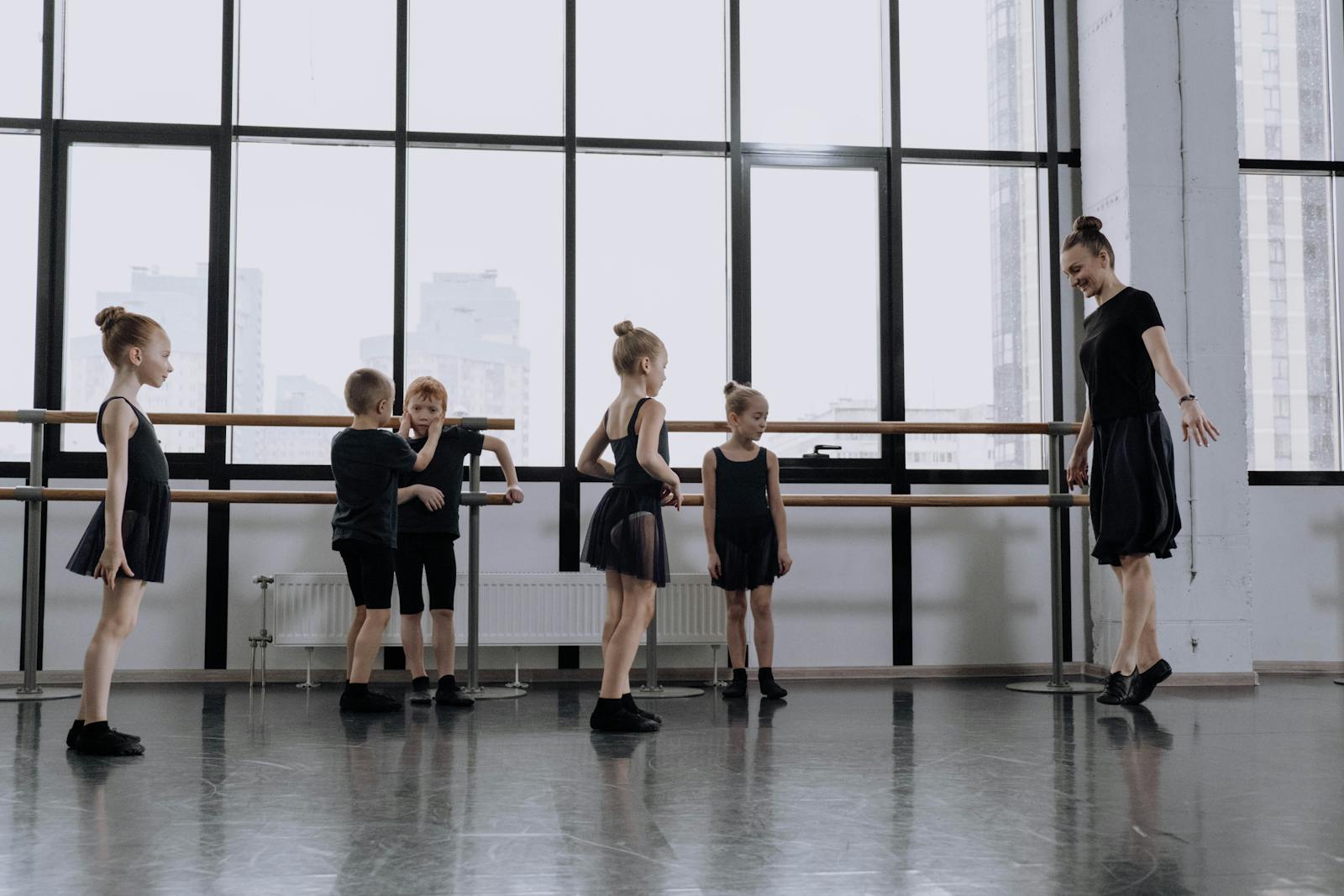
Around five, coordination and body awareness catch up enough for a child to copy a position and hold it, to remember a sequence of three or four things, and to notice, with a little help, that a knee is bent where it should be straight. This is where real ballet begins. At ARTIS it begins in Primary Ballet, for five- to seven-year-olds: sixty minutes, two or three classes a week on days the parent chooses, in a group of up to ten.
The class now has the shape it will keep for a dancer’s whole life, in miniature. It opens at the barre with the first real exercises, adapted to the age: pliés, tendus, small rises, each short enough to hold attention and slow enough to be done well. Then the children come into the centre to stand in the positions without the barre’s help, to carry the arms through the first port de bras, and to jump: small jumps from two feet to two feet, with a landing the teacher watches more closely than the height. Musicality is taught on purpose: children clap a rhythm before they dance it, and learn that the music decides when a movement begins.
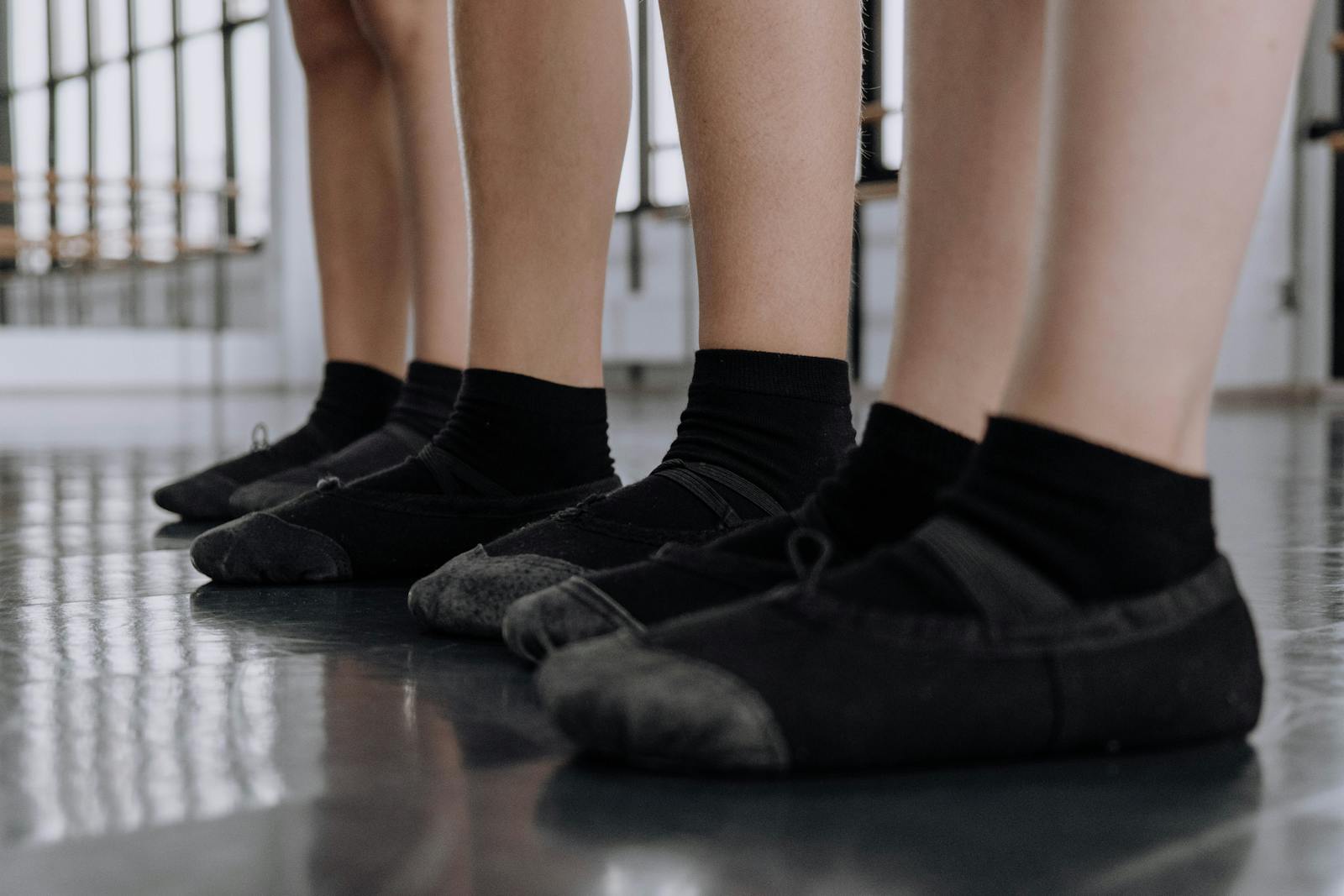
Corrections are gentle and physical, a hand on a shoulder, a finger under a chin. Nobody is drilled. A five-year-old with one good tendu at the end of a month has had a good month. Clothing becomes the classical uniform in its simplest form: leotard, tights, soft ballet shoes and hair tied back, so the teacher can see the line of the body and the child can feel it.
From eight: technique in earnest
From eight, a child can do something a five-year-old cannot: repeat an exercise many times with attention, and want to. The capacity for technique, for the patient repetition ballet is actually made of, arrives around this age, and the class grows into it. Junior Ballet at ARTIS, for eight- to twelve-year-olds, runs sixty minutes, two or three times a week, in a group of up to eight or nine.
The barre is now complete: pliés, tendus, jetés, ronds de jambe, in the order and with the coordination of the Vaganova method, the progression of the great Russian academies scaled to a child. In the centre there is adagio, the slow work that builds balance and line; small jumps; and the first turns, prepared for months before a full pirouette is attempted. Corrections become individual. The teacher names the child, names the problem, shows the fix and expects to see it tried next time. The first artistry appears here too: a head that turns with the arm, a hand that finishes a phrase, the beginning of dancing rather than exercising.
Two or three classes a week matter at this age for a reason that has nothing to do with ambition. The placement of feet, hips and spine is learned in these years, and the body has to meet the same instruction often enough to keep it. Hair goes into a bun from eight; it is part of the discipline, and it keeps the neck visible for corrections.
Twelve to fourteen, and the question of pointe
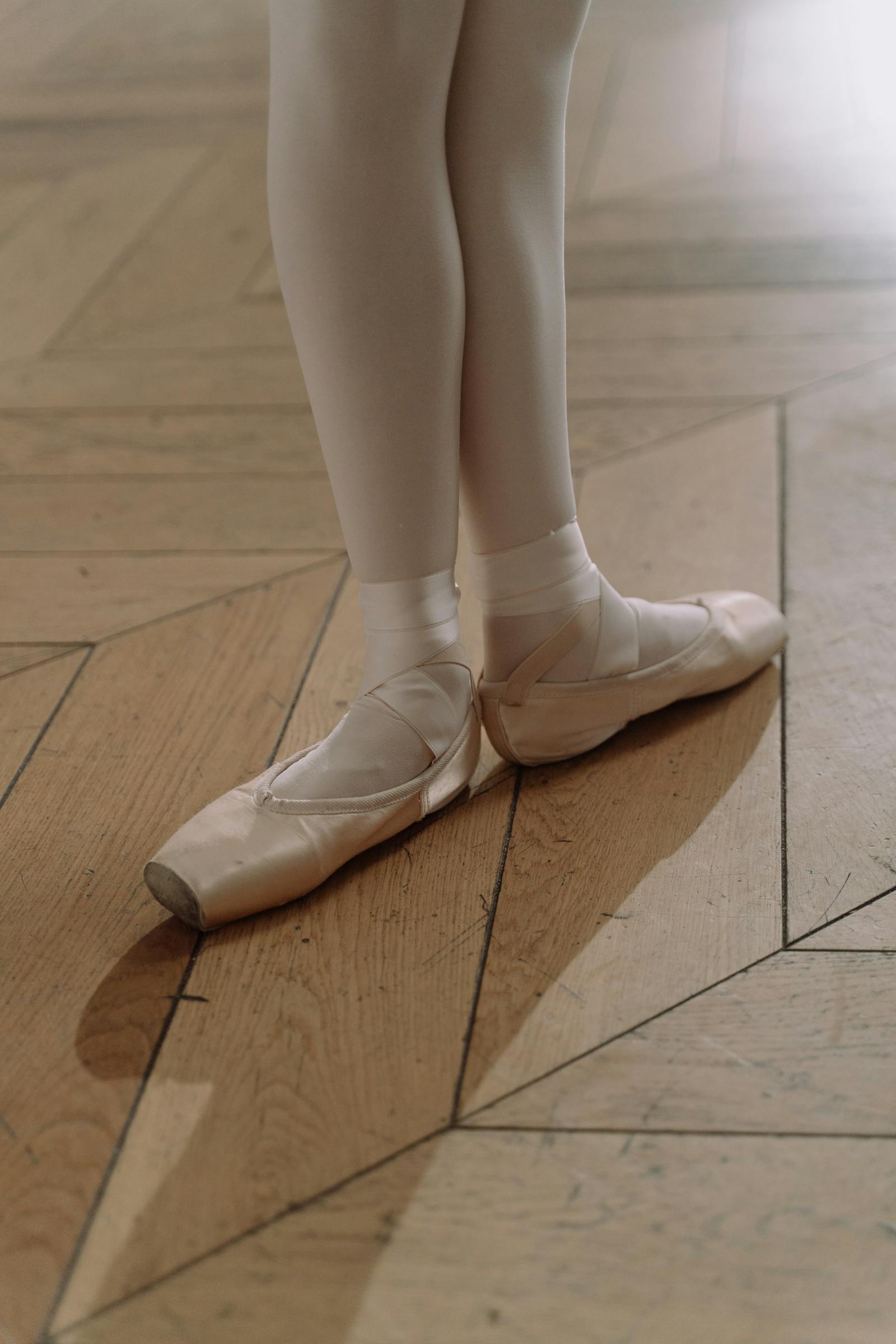
Teen Ballet at ARTIS, for twelve- to fourteen-year-olds, meets twice a week and welcomes beginners. Someone who starts at twelve is not behind; they begin a full barre and centre with an adult’s ability to understand an instruction and a child’s ability to absorb it. The work is posture and placement, the full vocabulary at the barre and in the centre and, for those with some years of training, the preparation for pointe work: strength in the feet, ankles and trunk, built over months. Pointe itself comes only after a readiness assessment, never as a reward for age or enthusiasm; a separate article on this site explains what readiness means and how a studio should test it.
For children of ten to thirteen with at least two years of ballet who are considering a professional path, there is a Pre-Professional Junior group with four classes a week, led by Alexandra, a Vaganova Academy graduate and former Mariinsky dancer.
A class explains itself better than a page
Children’s ballet at ARTIS in Vienna runs in small groups by age, from Pre-Ballet at three to Teen Ballet, taught by professional dancers in English, German and Russian. The trial class for children is free and arranged with the studio.
What a children’s class is not
It is worth saying plainly what does not happen in a class at a serious ballet school for children, because parents sometimes expect it and are relieved to hear otherwise.
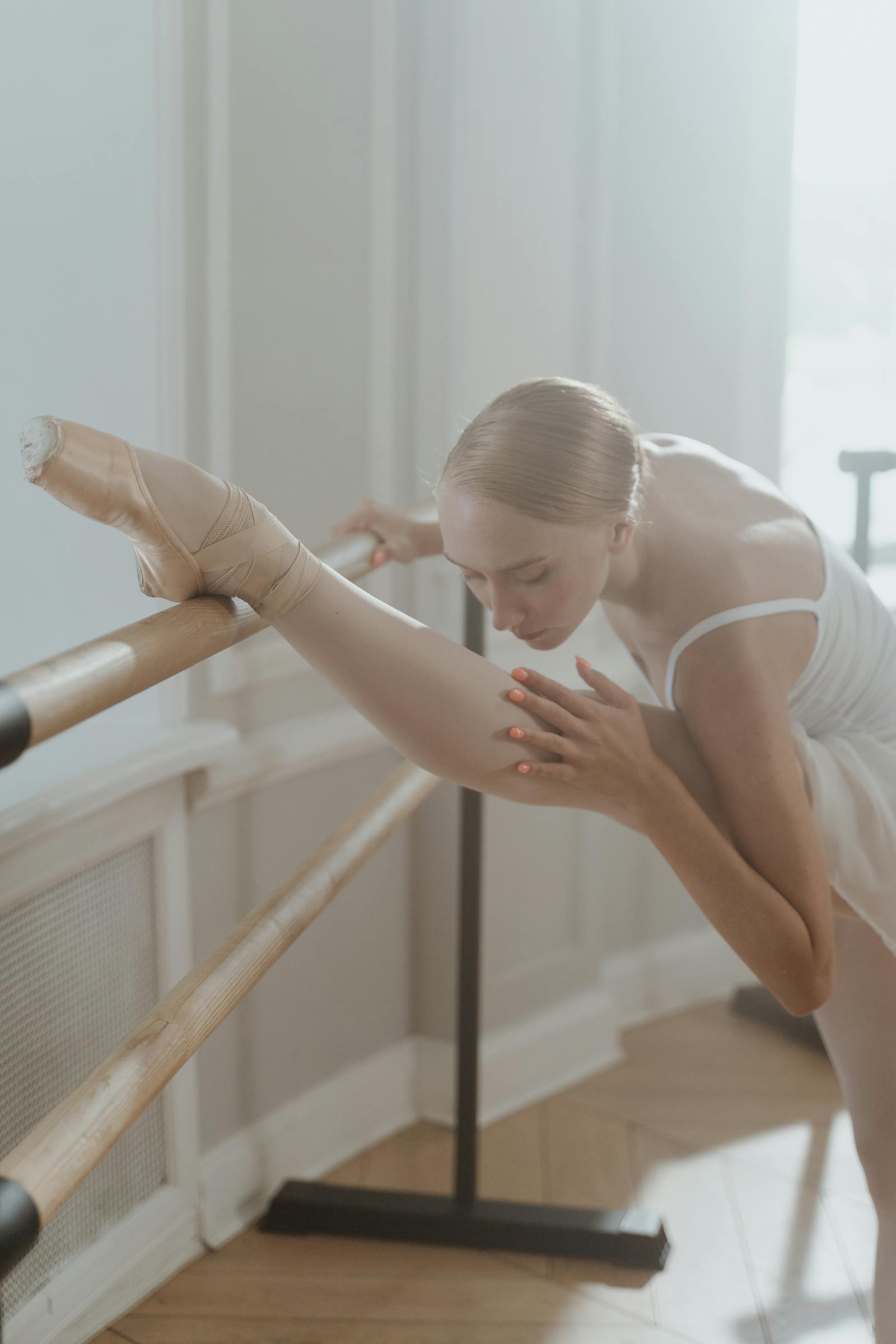
There is no drilling. Repetition is measured to the age, and a class that leaves a five-year-old bored or a nine-year-old in tears has the measure wrong. Nobody is pushed into the splits. Flexibility is trained slowly, in a warm body, within what each child’s joints allow, and the teacher is the person who says stop. There are no competitions and no medals. Ballet is not a sport with a score; what a child gains from it is posture, coordination, musicality, concentration and a healthy back, and none of that can be ranked against the child on the next mat. And no child goes on pointe early, however much they want to or a parent asks.
What there is instead is structure. Class begins the same way each time, the exercises come in an order the children learn to expect, the teacher is addressed with respect and speaks to the children with the same courtesy. Small children find this calming. It is the opposite of pressure.
How to tell if a school is good for children
Whatever ballet school for children you are considering, four things tell you most of what you need to know. The group is small: eight to ten children is a class, twenty is a crowd, and in a crowd the quiet child is invisible. The teacher names the child: within the first weeks she should know your child’s name, what they find hard and what went better today, and be able to tell you in a sentence. There is structure without pressure: the same shape every week, real corrections, no shouting, ranking or forced stretching. And the first class is a real class in the real group, not a show lesson, because the class your child tries is the class they will get. If any of this is missing, the method on the website does not matter.
At ARTIS the trial class for children is free and arranged with the studio rather than booked online. Write to us with your child’s age and the days that suit you, and we propose a group and a date. If you continue, children’s memberships run monthly with a written participation contract, three months at the minimum and two months’ notice; current prices are on the children’s page. The studio is at Rockhgasse 1 in the 1st district, a few minutes from U2 Schottentor and U3 Herrengasse, so the trip after school is short from the 2nd, 3rd and 9th districts.