COMPARE · DISCIPLINES
Ballet vs Pilates vs Barre What's the Difference
Three related disciplines, three different answers. What each one actually is, what it measurably builds, and which one fits which goal.
Alexandra·7 min read·MAY 2026
The three disciplines are often listed in the same breath, which is the first source of confusion. Pilates, barre, and ballet share visual cues — a barre on the wall, music with a count, vocabulary like plié and relevé — and the boutique-fitness industry blurs the lines further. They are not the same thing. One is a rehabilitation-grounded conditioning system from nineteen-twenties New York. One is a group-fitness format from a London dance-rehabilitation studio in 1959. One is a four-century classical art form with an eight-year vocational syllabus. They produce different bodies and different skills. This article disambiguates the three with citations rather than marketing copy.
Pilates — what it actually is
Joseph Hubertus Pilates was born in Mönchengladbach, Germany, in 1883, and emigrated to New York in 1926. He opened the Contrology studio on Eighth Avenue with his wife Clara; the first clients included dancers sent over by George Balanchine of New York City Ballet and by Martha Graham. The method was originally a rehabilitation system built by a sickly child to fix his own body.
The six principles most studios cite today — centring, concentration, control, precision, breath, flow — were not coined by Joseph himself. They were codified posthumously in Friedman and Eisen's nineteen-eighty book The Pilates Method, and later formalised by the Pilates Method Alliance. The classical lineage runs through Romana Kryzanowska, Joseph's named successor after his death in 1967.
Pilates is delivered in two modes: mat work using bodyweight, and apparatus work using the Reformer, Cadillac, Wunda Chair, and Barrel — spring-loaded equipment Joseph designed himself. A new classical Reformer runs one thousand two hundred to five thousand dollars, which is why studio Reformer classes cost more than mat.
The evidence base is the strongest of the three disciplines compared here. A meta-analysis of ten randomised controlled trials with eight hundred and two participants found Pilates produced a standardised mean difference of minus one point two five in pain, and minus zero point seven eight in disability, for chronic low-back pain. Systematic reviews show consistent gains in flexibility, dynamic balance, and core muscle thickness in healthy adults.
Barre — what it actually is
Lotte Berk was a German dancer with a serious back injury who opened her first studio on Manchester Street, London, in 1959, fusing barre work, dance conditioning, and rehabilitation exercises. The format crossed to New York in 1971 via Lydia Bach. Three decades later Burr Leonard, a former Lotte Berk instructor, worked with physical therapists to remove unsafe movements and launched The Bar Method in San Francisco in 2001 — the version most North American studios descend from.
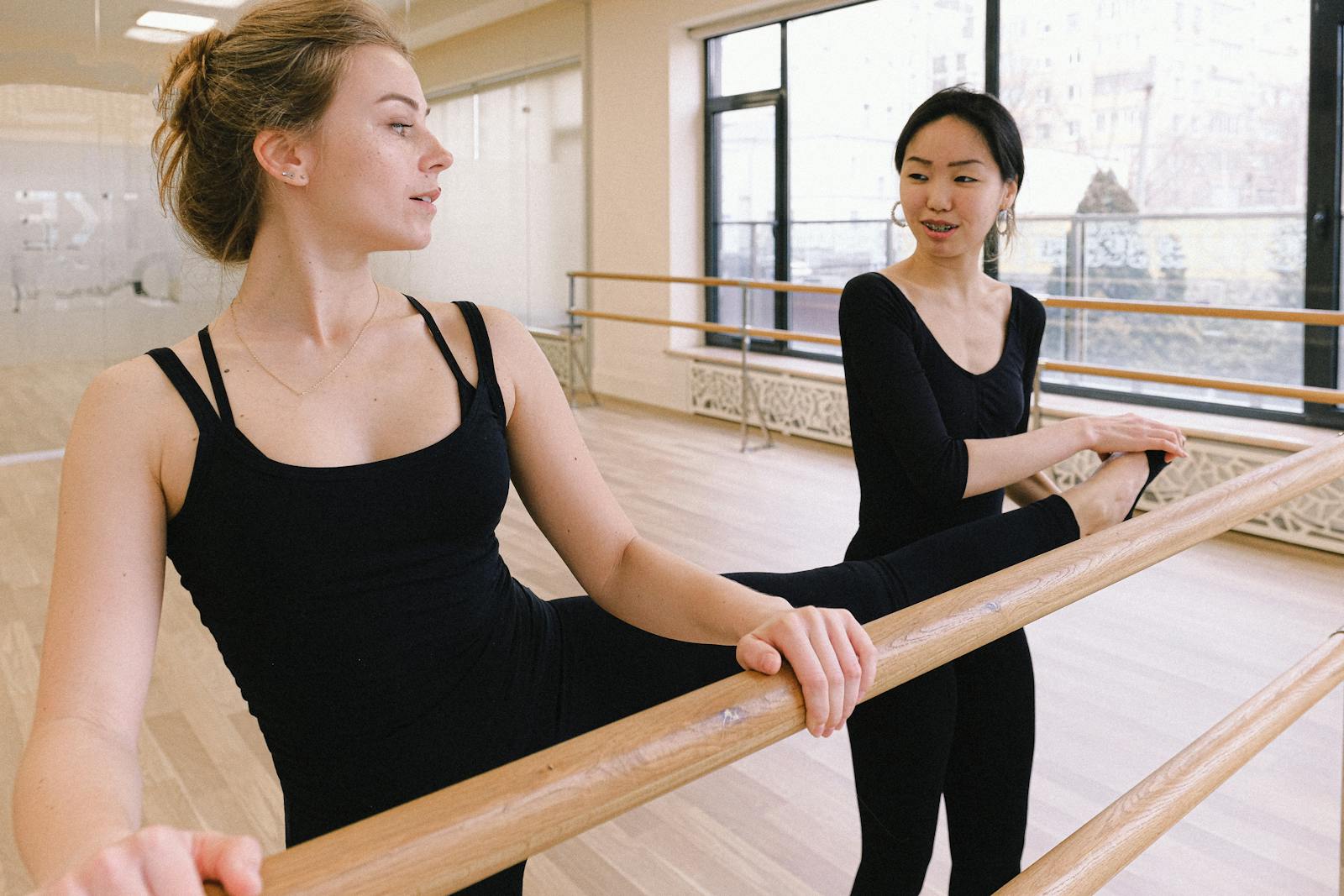
The technical formula is consistent across franchises: isometric pulses, ballet-derived positions (plié, relevé), Pilates-style core work, and light weights or balls. High repetitions are taken to muscular fatigue — the "shake" practitioners describe. The branded landscape is fragmented. Pure Barre (Carrie Rezabek Dorr, Birmingham, Michigan, 2001) is the largest United States franchise. Barre3 (Sadie and Chris Lincoln, Portland, 2008) adds explicit cardio bursts and breathwork. Xtend Barre is the most ballet-literal, retaining vocabulary including tendu and sous-sous.
The peer-reviewed evidence base is thin, and worth flagging honestly. One eight-week study in sedentary office workers found three weekly barre sessions increased lower-limb and core endurance versus a control group. The American Council on Exercise states the matter directly: research on specific barre formats has not been published in peer-reviewed journals. Most claims rest on adjacent strength-training literature.
Ballet — what it actually is
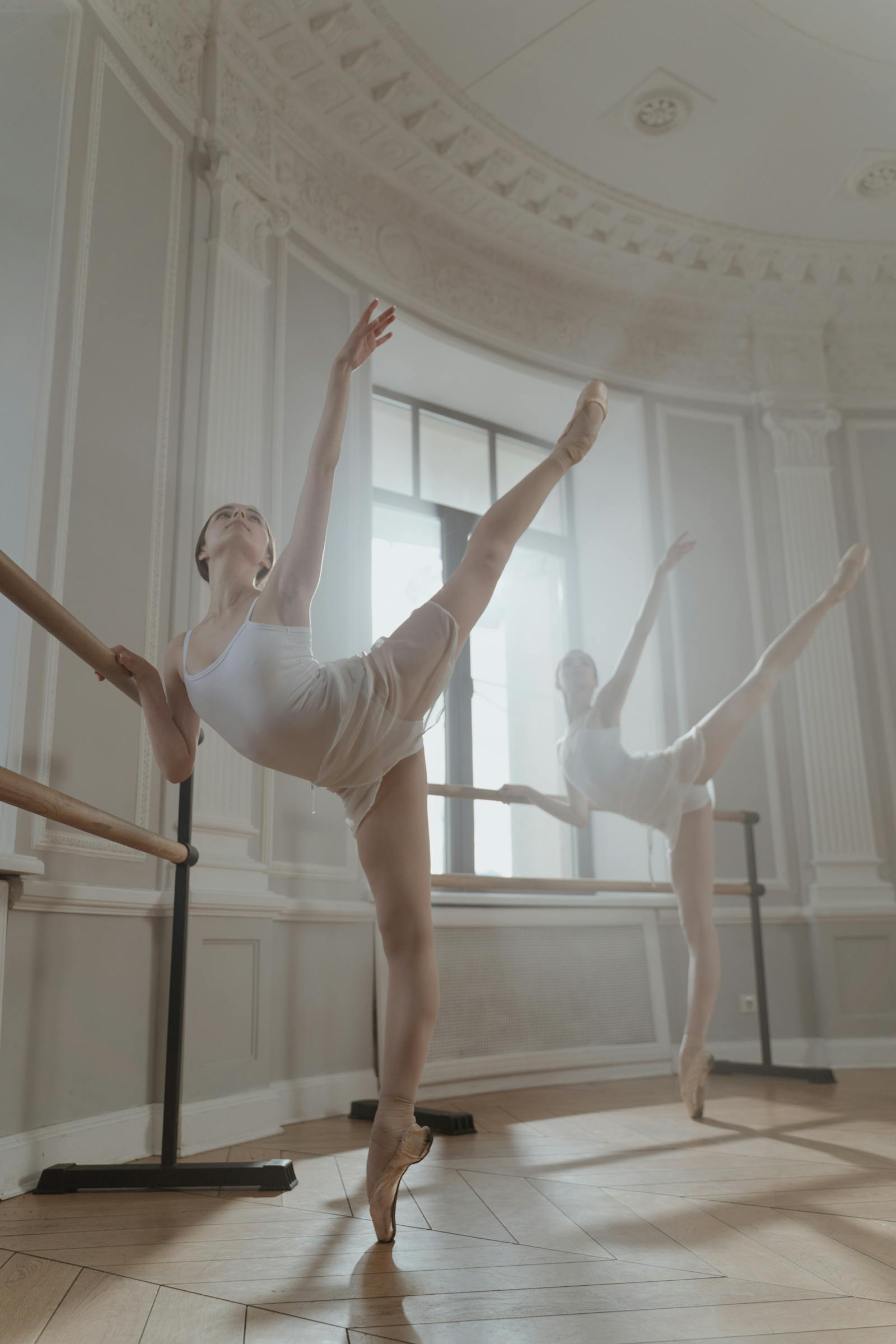
Ballet is a classical technique codified across four centuries, originating at the French court in the seventeenth century and reaching its modern technical form through nineteenth-century Russian schools. Five positions, turnout from the hip, épaulement, and a French and Italian vocabulary that survives intact from Saint Petersburg to Vienna. The technique is delivered through named methods — Vaganova, RAD, Cecchetti, Balanchine, French school — each with its own pedagogical signature. The companion article on the Vaganova method covers the differences in detail.
The vocational path is an eight-year syllabus, six days a week, roughly ages ten to eighteen. The adult open-class path uses the same vocabulary without the exam ladder. Documented effects include higher bone mineral density at weight-bearing sites and superior proprioception in trained dancers. The documented downside is body-image risk: over sixteen percent of ballet dancers screen positive for eating disorders, against two to eight percent of the general female population. Adult studios are obliged to acknowledge this.
Side-by-side — the comparison that matters
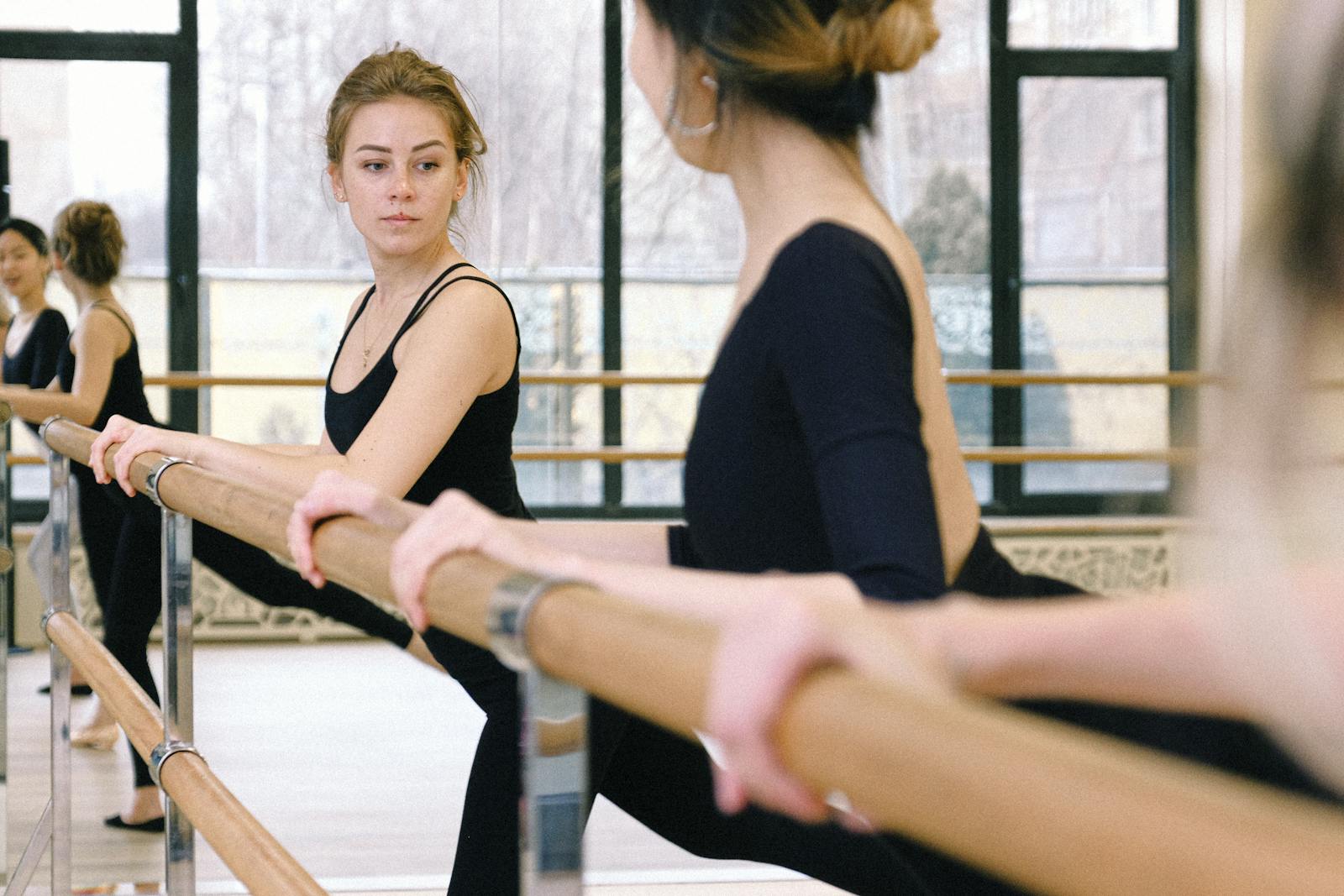
The three diverge on a handful of concrete dimensions. Origin: Pilates is nineteen-twenties New York; barre is 1959 London via 2001 San Francisco; ballet is seventeenth-century France via nineteenth-century Russia. Primary focus: Pilates trains core strength and control; barre trains lower-body endurance and posture; ballet trains skill, coordination, and artistry. Music: Pilates uses it as background or omits it; barre uses choreographed playlists; in ballet, the phrasing of the music dictates the movement.
Skill ladder: Pilates has a teacher-certification path but no student grades; barre has no student ladder at all — leaving Pure Barre for Bar Method means relearning the choreography; ballet has both an eight-year vocational syllabus and an adult open path with progression over years. Apparatus: mat or Reformer for Pilates; barre, light weights, a small ball for barre; sprung floor, barre, mirrors, and pointe at advanced level for ballet. Cardio is low for Pilates, low to moderate for barre (Barre3 the highest), moderate to high in ballet centre and allegro. Classes run forty-five to sixty minutes for Pilates and barre; sixty to ninety for ballet open classes.
If a skill is what you want, ballet is the one with the ladder
ARTIS Ballet Vienna teaches the Vaganova method — adults and children, small groups, classes in English and German.
Which for whom — honest answer
Choose Pilates if the priority is rehabilitation, chronic low-back pain, or post-pregnancy core re-education. The peer-reviewed literature is unambiguous, and no other discipline compared here matches it.
Choose barre if the priority is low-impact strength and posture in a high-energy group setting with zero skill barrier, no learning curve, and no expectation of progression over years. The format is honest about what it is — group fitness with ballet-flavoured aesthetics — and that is a legitimate thing to want.
Choose ballet if the priority is a skill: something to learn for decades, with music as a partner rather than a backdrop, a four-century vocabulary, and progression that does not plateau at month six. The trade-off is a slower learning curve, and the obligation to choose a studio that has done its work on the body-image question.
The three stack well, which is the final point. Joseph Pilates' earliest New York clients were Balanchine's dancers — the conditioning system was designed for ballet bodies first. An adult ballet student doing Pilates on a non-class day is doing what professional dancers have done for ninety years. Adding barre to that mix does no harm and is enjoyable, which is reason enough.