GUIDE · ADULTS
Adult Beginner Ballet in Vienna
An honest guide to your first class — what your body actually needs, what to wear, and what to expect.
Alexandra·7 min read·MAY 2026
Adults who consider their first ballet class usually arrive with a question they will not say aloud: is this still allowed for me. The honest answer is that adult-onset ballet is a researched, well-tolerated practice — not a hobby that requires forgiveness from the discipline. What follows is a guide to three things: what your body actually needs to begin, what happens in a first lesson, and how to choose between the studios of Vienna. The facts, and a clear view of the room.
Is it too late at thirty, forty, fifty
The cultural assumption is that ballet belongs to children and ends with adolescence. The research does not support it. A ten-week classical ballet intervention in adults aged fifty and above produced significant improvements in lower-limb strength and balance, with no adverse events reported. Twelve-week programmes in older women show the same direction — improved dynamic balance, postural stability, and strength. Clinical trials in adults from fifty into the seventies treat adult-onset ballet as a legitimate intervention, not an implausible one.
The motor-learning literature is more nuanced than the "children are sponges" headline. When ten-year-olds, young adults, and older adults are tested on an unfamiliar motor task from similar baselines, adults are not categorically worse. Children consolidate motor memory within roughly an hour after training; adults need more time, including sleep. The capacity is preserved into older age — its timing is different, not its existence. Dance, specifically, produces greater neuroplastic changes in older adults than repetitive exercise of equivalent dose.
This does not mean a forty-five-year-old will pirouette like a fifteen-year-old. It does mean that there is no biological cut-off where the body stops learning the work.
What your body actually needs to start
Three pieces of received wisdom need to be set aside before the first class.
The first is turnout. Roughly sixty percent of turnout comes from the hip joint, twenty to thirty percent from the ankle, the remainder from the knee and tibia. Average hip external rotation sits between fifty-one and sixty degrees. A one-hundred-and-eighty-degree first position is biomechanically unavailable to many healthy adults, and forcing it is the single most documented injury cause in recreational dance. Dancers who reach the full range do so by combining contributions from several joints — and the studios that matter teach within available range, not against it.
The second is the "ballet body". Selection bias from the Balanchine era left a visual stereotype that has nothing to do with whether the technique can be learned. Dance medicine treats the pursuit of extreme thinness as a known harm — it correlates with stress fractures and the loss of the strength the work actually requires.
The third is flexibility. The IADMS guidance is direct: range-of-motion stretching to end-range happens only when the body is warm, which means after the class has begun, not before. Strength, flexibility, and aerobic capacity are trainable through dance itself. The Wiener Staatsoper Ballett-Akademie gates its adult open class on prior ballet exposure and basic terminology — not on flexibility or body type.
What you need to begin is a body that can stand upright and pay attention. The rest is built in the room.
What actually happens in a first class
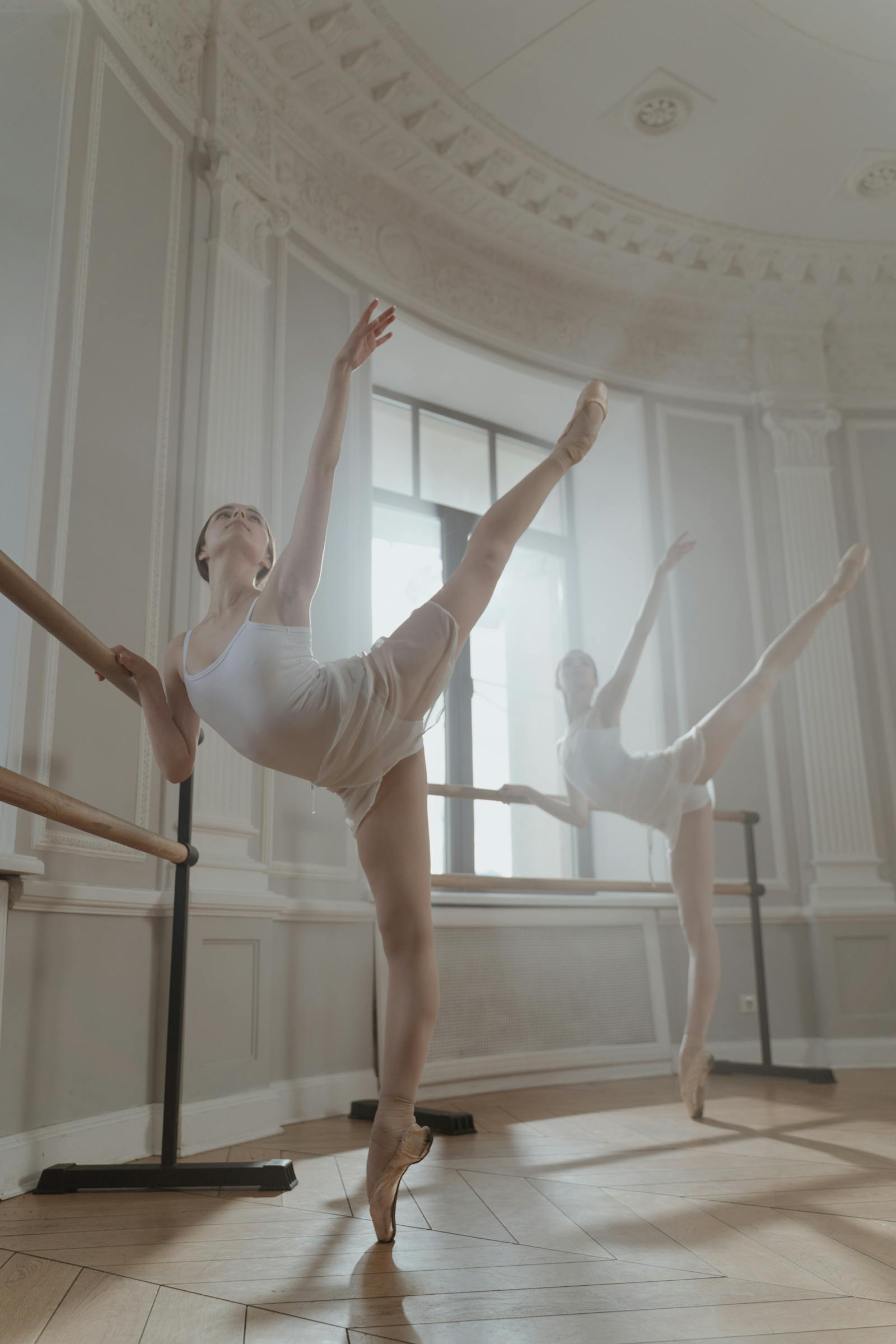
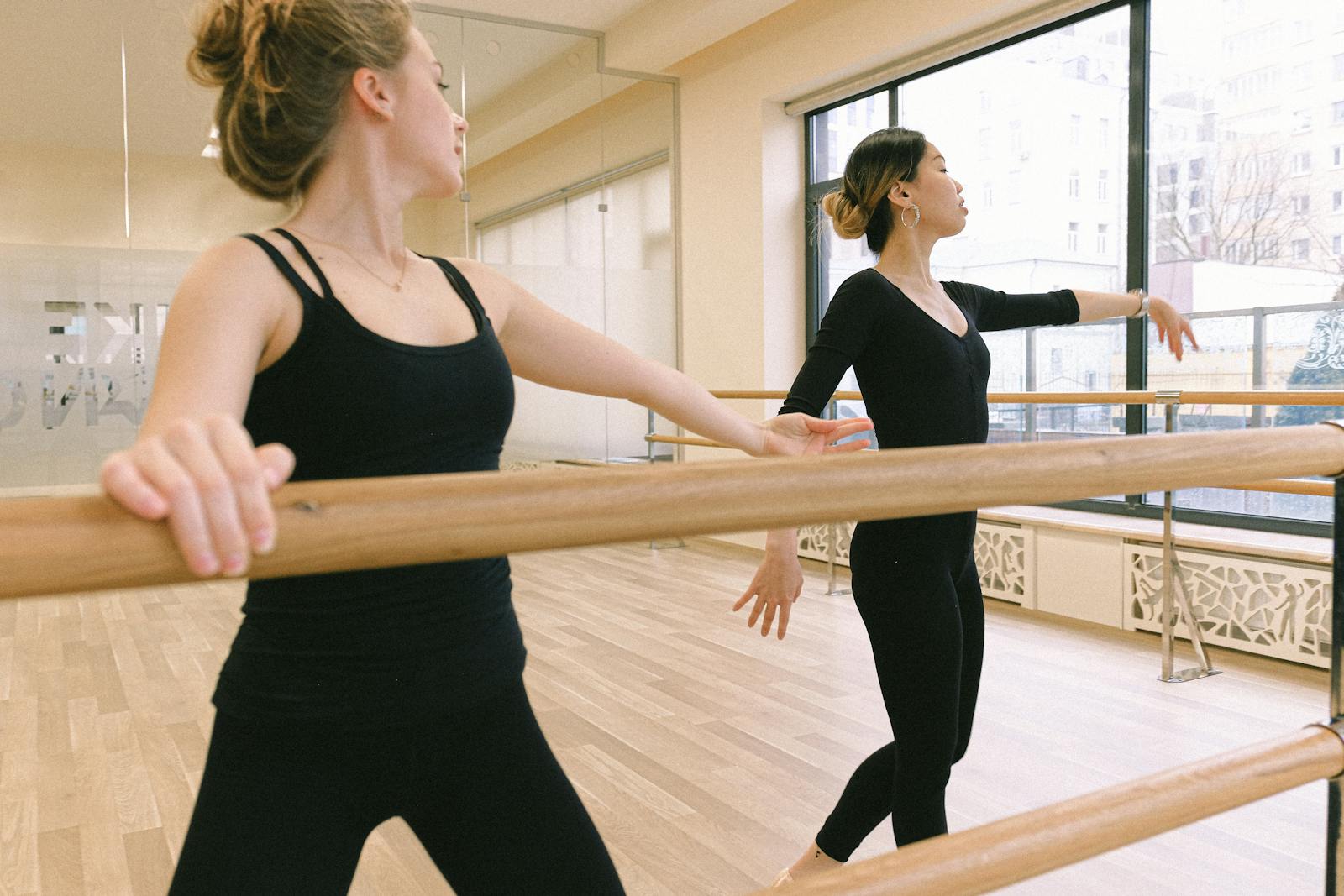
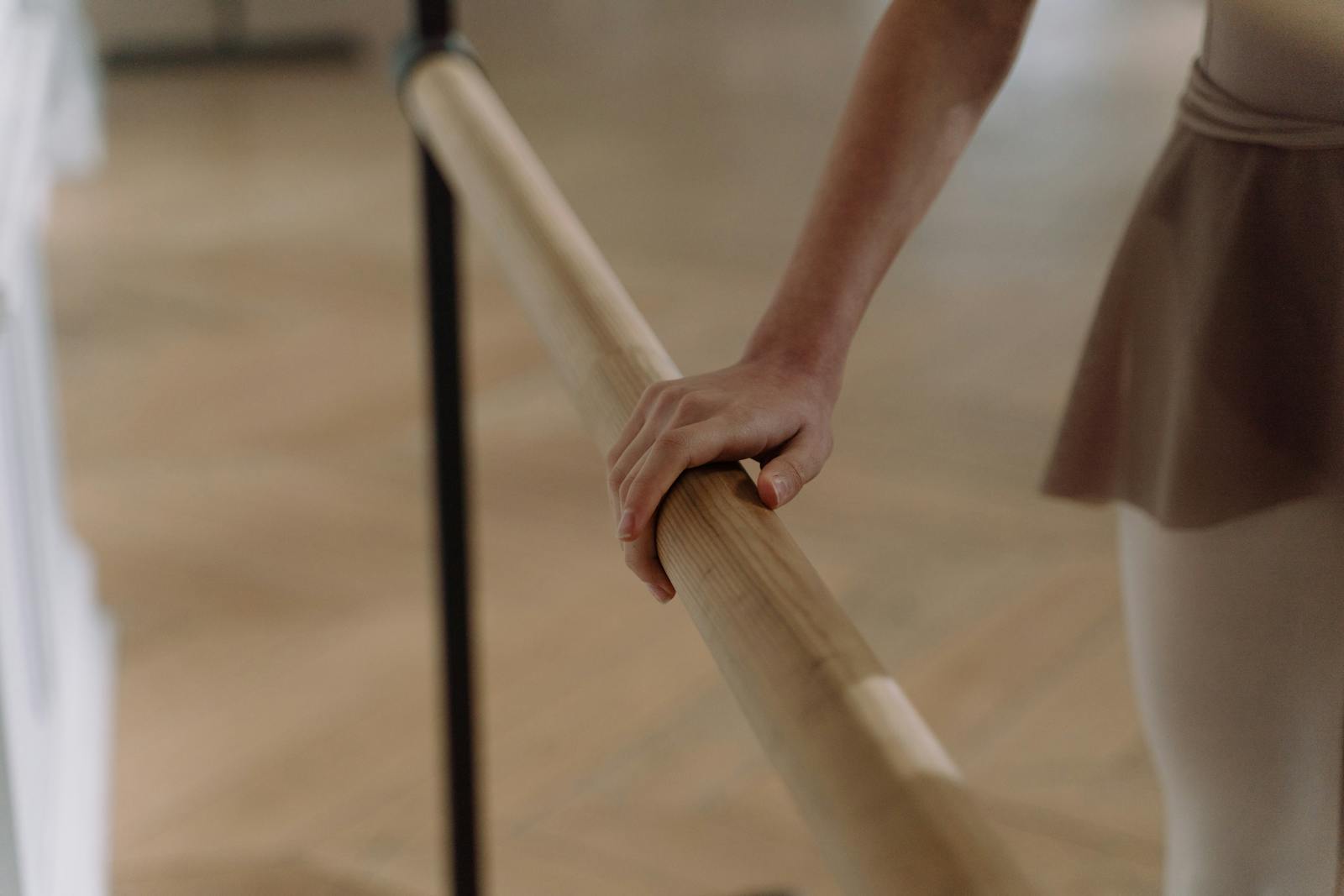
A Vaganova-method class follows a fixed sequence — the same shape every time, the same vocabulary every time, varying only the difficulty. The opening section is at the barre: pliés, tendus, dégagés, repeated in slow tempo with progressively more coordination of the back, arms, and head. The middle section moves to the centre of the floor with the same vocabulary, now without the barre's support. A first class for absolute beginners stays at this level; jumps and turns enter in later weeks.
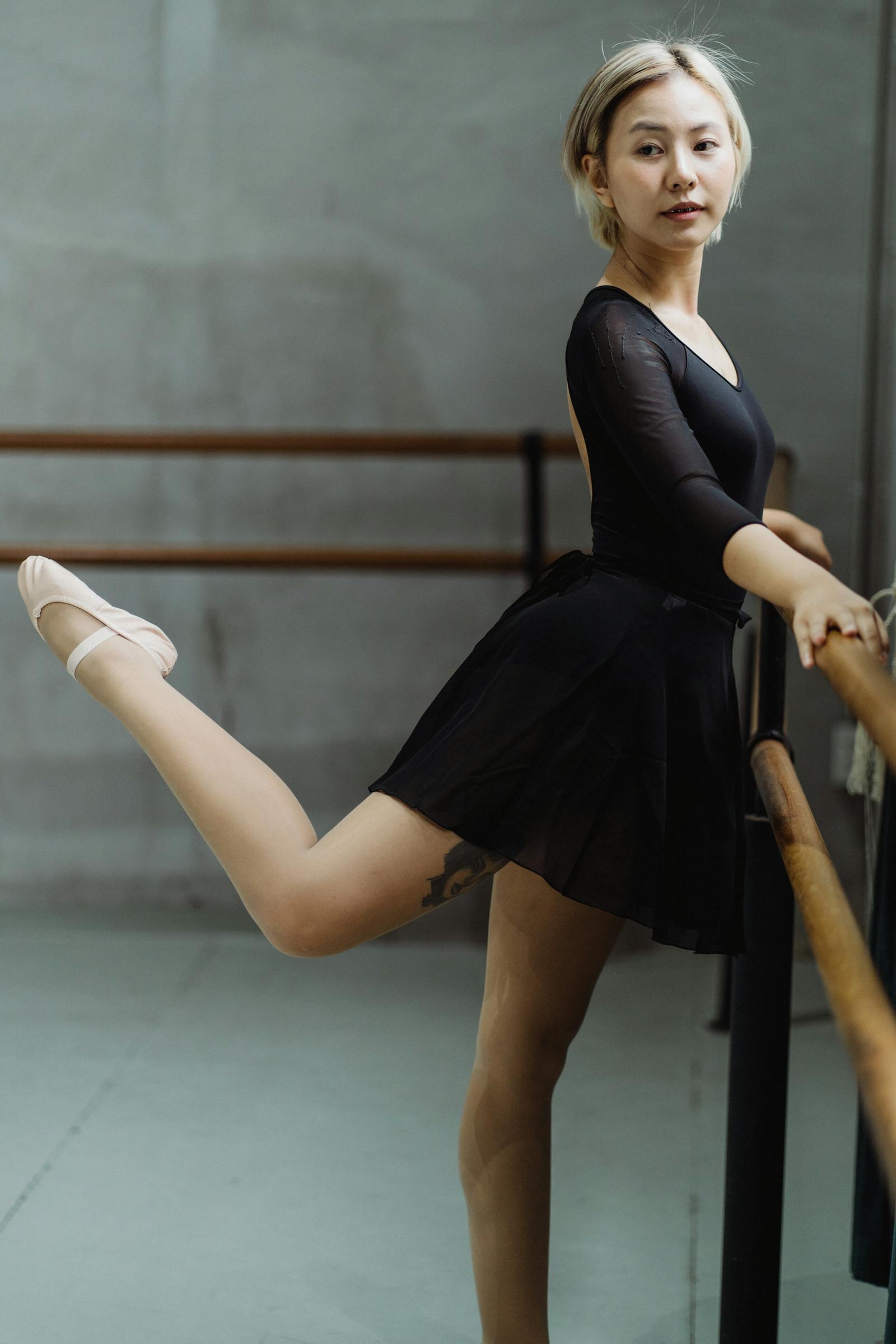
Arrive ten minutes early — enough to change without rushing and let the room settle before the music begins. A fitted top, leggings or capri leggings, and socks with grip are sufficient for the first weeks. Ballet slippers are welcome if you already own them, not required if you do not. Tie your hair back. Tell the teacher you are new — one sentence is enough; every honest studio adjusts pacing on that signal.
Why method matters (and why we teach Vaganova)
Most Vienna ballet studios do not name the method they teach. The few that do mostly name Vaganova — for good reasons that beginners rarely hear stated plainly.
Vaganova was engineered to teach the whole body. Every exercise coordinates the back, arms, head, and legs from the outset; the method is built around six codified port-de-bras patterns trained early, so that arm and torso coordination develop alongside the legs rather than after them. The system gates each new step on the strength prerequisites for it — which makes it particularly well-matched to adult bodies that need conservative, layered loading.
Other methods are not worse — they are differently shaped. Balanchine prizes speed, attack, and extreme line; the entry barrier into a Balanchine class from cold is higher for an untrained adult body. Cecchetti is a codified daily sequence, beautiful and demanding. RAD is the graded-examination standardisation — useful when measurable progression matters. Method choice is a pedagogical priority, not a quality ranking. Choose the one that fits how you actually learn — and ask the studio which it teaches, because the answer should not be a vague one.
The mirror
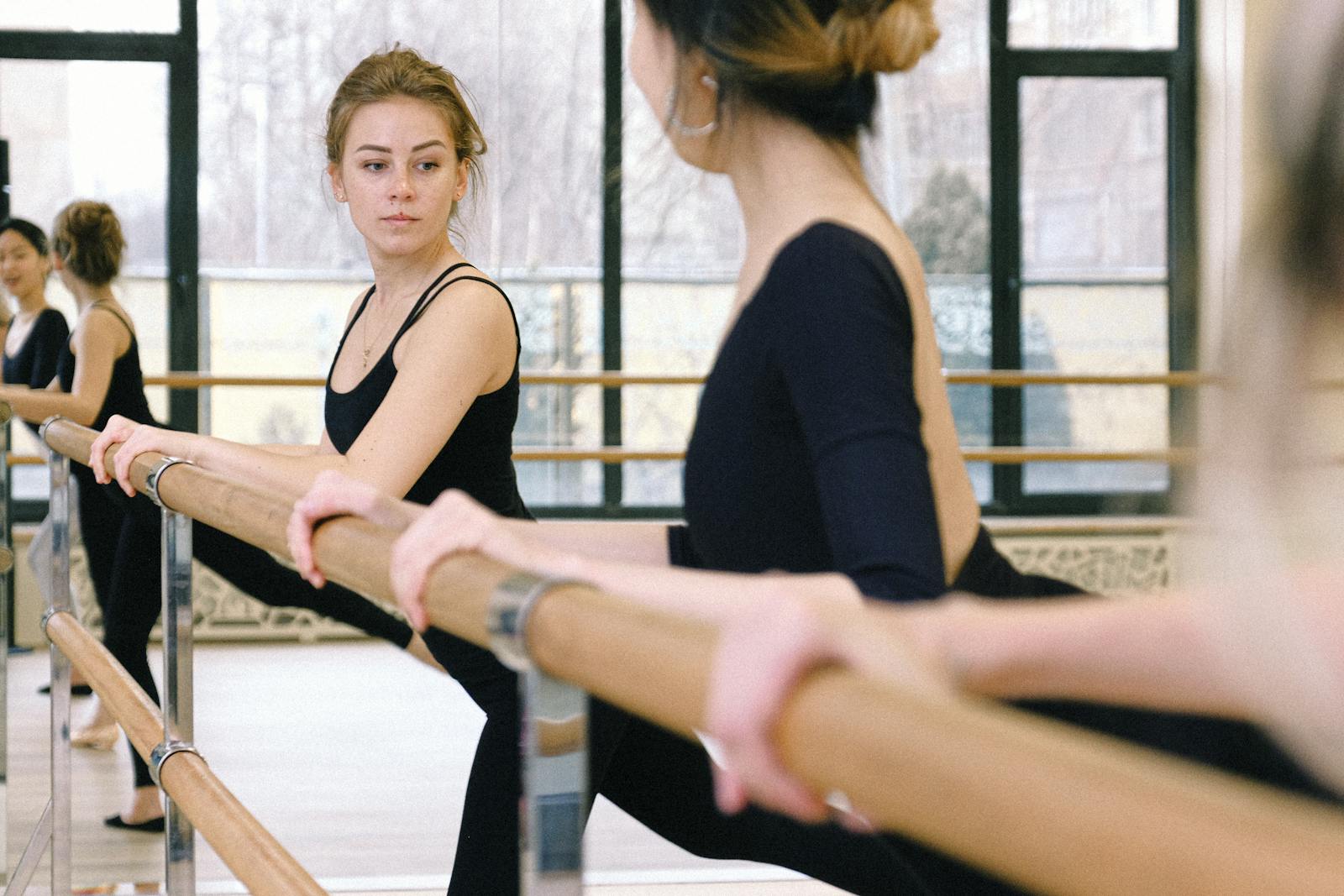
Studio mirrors are a research topic. The IADMS — the International Association for Dance Medicine and Science — has published a dedicated paper on mirror effects in dance class. Beginning students in mirrored classes report objective self-awareness, social comparison, and negative self-evaluation; body satisfaction drops in mirrored classes regardless of dance genre.
The motor-learning literature points further. Looking at a mirror tends to direct the dancer's attention internally — toward the body part being observed — which degrades motor learning compared with an external focus. Roughly ninety percent of dance instruction worldwide is internally focused. Reducing reliance on the mirror lets adult dancers progress from technique to artistry by trusting kinaesthetic feedback rather than visual self-monitoring.
The practical translation: looking at the floor for the first weeks is permitted. The mirror is a tool, not an examiner.
The room is the only honest test
Open ballet classes in Vienna run six days a week at ARTIS. The first class is a single class, booked on its own in the app; the membership can wait until you know you want one, and that first class is then credited towards its first month.
Frequency, conditioning, and how injuries actually happen
In practice, one class a week is a sustainable starting cadence; most adults find that two classes is where progress becomes visible within a few months. Twice-weekly bodyweight strength sessions — squats, lunges, bridges, planks — help the body absorb the load. Cardio matters longer term, because traditional ballet class is intermittent rather than aerobic, but it does not need to be in place before the first lesson.
Recreational ballet has an injury incidence below five per thousand dance hours — comparable to many recreational sports. Specifically in amateur ballet, the rate is closer to one per thousand. The dominant injury mechanism is repetitive movement, not dramatic execution; overuse accounts for roughly two-thirds of all ballet injuries. The single most documented risk factor across the literature is forcing turnout beyond what the hip joint allows — injured dancers showed a mean compensated turnout of twenty-five degrees, against under five degrees in uninjured peers. Compensating that limitation downstream at the knee and ankle is the direct mechanism behind most lower-back, knee, and foot pain in ballet.
The discipline is not in matching the dancer beside you. It is in stopping at what your body actually has.